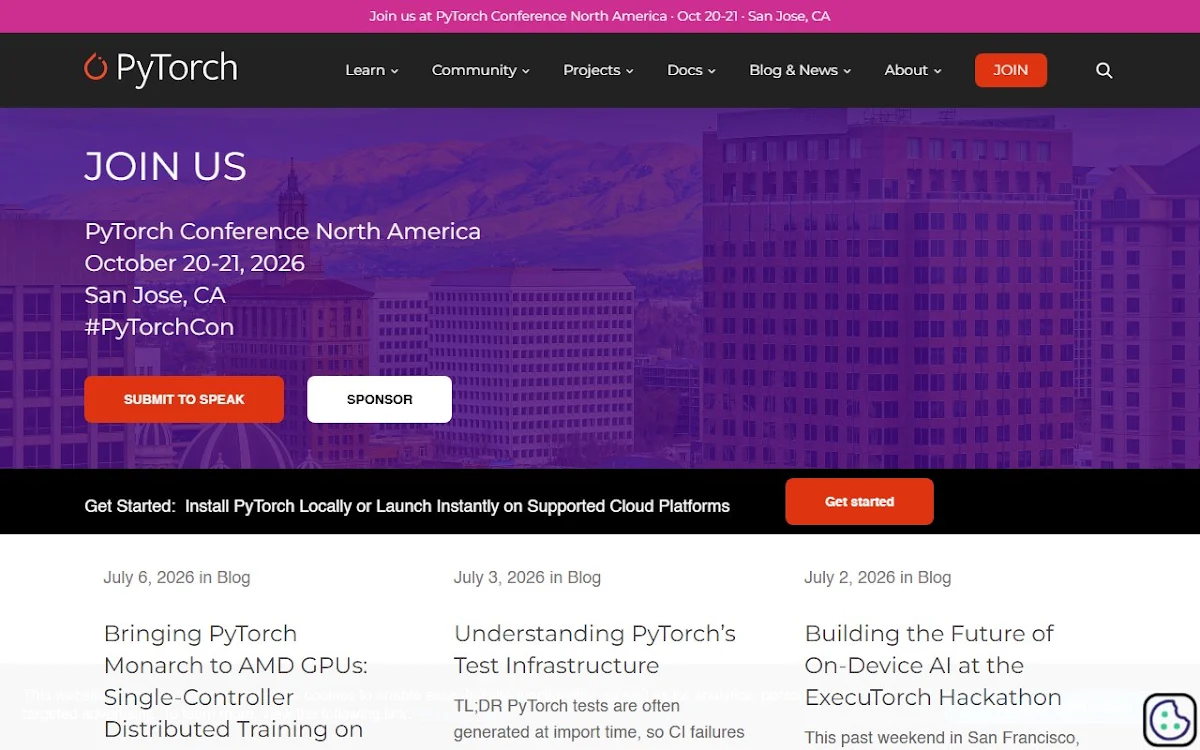

PyTorch
PyTorch: Tensores y redes neuronales dinámicas en Python. (Herramientas para desarrolladores e inteligencia artificial)
Title: A Comprehensive Overview of PyTorch: A Robust Artificial Intelligence Tool for Modern Development
PyTorch, an open-source machine learning (ML) library developed by Facebook's AI Research lab, is a powerful tool for researchers and developers working on artificial intelligence (AI) projects. It provides a flexible and efficient platform for creating and training deep neural networks, empowering users to develop and deploy a wide range of AI applications.
1. What is PyTorch and its purpose
PyTorch is a dynamic computational framework that allows users to build and train deep learning models, conduct research, and accelerate the development of AI applications. It is designed to provide an intuitive and accessible approach to deep learning, making it easier for researchers and developers to create and experiment with complex AI models.
2. Problem it solves
PyTorch addresses the challenges of developing, training, and deploying deep learning models by providing a flexible, user-friendly platform that allows for rapid prototyping and experimentation. It simplifies the process of creating and optimizing neural networks, enabling users to develop AI solutions for a variety of tasks, such as image and speech recognition, natural language processing, and more.
3. Key features
- Dynamic computational graph: PyTorch's dynamic computational graph allows for efficient and flexible tensor operations, enabling users to easily manipulate and modify their models during runtime.
- Strong GPU support: PyTorch offers robust support for NVIDIA GPUs, allowing for efficient computation and accelerated training times.
- Automatic differentiation: PyTorch's automatic differentiation feature simplifies the process of calculating gradients, making it easier for users to optimize their models.
- Pythonic API: PyTorch's Pythonic API makes it easy for developers with Python experience to quickly get started with deep learning.
- Seamless TorchScript JIT compilation: PyTorch's TorchScript JIT compiler allows for efficient deployment of models to a variety of platforms, including web browsers and mobile devices.
4. Real-world uses
PyTorch is used in a wide range of industries and applications, including:
- Computer vision: PyTorch is used to develop AI models for image and video analysis, such as object detection, image segmentation, and facial recognition.
- Natural Language Processing (NLP): PyTorch is used to build AI models for tasks like speech recognition, machine translation, and sentiment analysis.
- Robotics: PyTorch is used to develop AI models for robotics, including reinforcement learning and control systems.
- Finance: PyTorch is used to develop AI models for financial analysis and prediction, such as stock price forecasting and risk assessment.
5. Target audience
PyTorch is primarily targeted at data scientists, machine learning engineers, and researchers who are working on AI projects and want a flexible, user-friendly platform for creating and training deep learning models.
6. Advantages and disadvantages
Advantages:
- Flexible and intuitive API
- Strong GPU support
- Efficient automatic differentiation
- Seamless TorchScript JIT compilation
Disadvantages:
- Less mature than some other deep learning libraries, such as TensorFlow, which may lead to slower performance in some cases
- Smaller community compared to TensorFlow, which may make it more difficult to find solutions to specific problems
7. Comparison with alternatives
Compared to other deep learning libraries like TensorFlow and Keras, PyTorch offers a more flexible and intuitive API, making it easier for users to quickly prototype and experiment with their models. However, TensorFlow is more mature and has a larger community, which may make it a better choice for production-level applications. Keras, on the other hand, is a high-level API built on top of TensorFlow and offers similar benefits to PyTorch, but with a focus on simplicity and ease of use.
Pricing Model
PyTorch is open-source and free to use for both commercial and non-commercial purposes. There is no trial or subscription required, and users can access the entire library without any restrictions. However, to take advantage of the GPU acceleration, users will need to have access to an NVIDIA GPU or a cloud-based GPU service. For commercial applications, it is recommended to consult with NVIDIA for licensing information, as they offer enterprise versions of PyTorch with additional features and support.
También puede interesarte.

Cree aplicaciones de voz de vanguardia con las tecnologías de Neon AI. El SDK de Neon AI integra IA avanzada y comprensión del lenguaje natural en una plataforma de ingeniería de software cohesiva. Piense en Amazon Alexa, Google Home, Apple Siri y Microsoft Cortana, todo con software gratuito de código abierto. También tienen un sistema operativo de IA para Mycroft Mark II en su sitio web.