
GGML
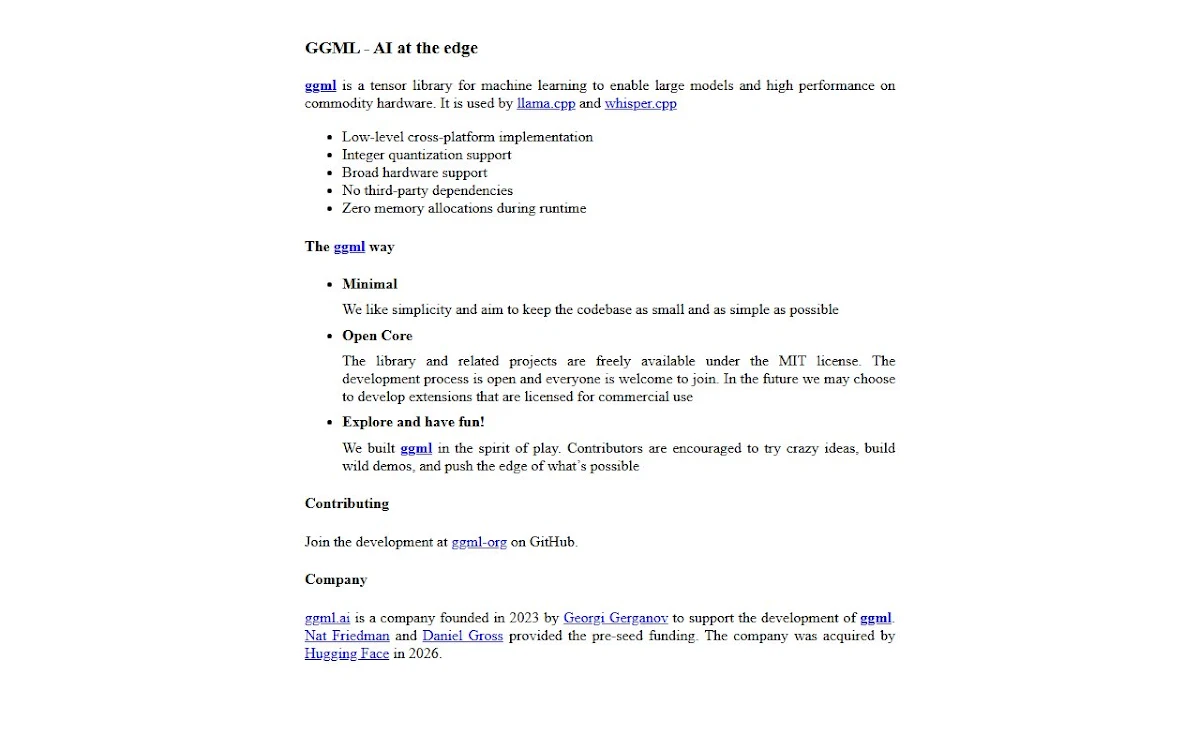
GGML (Aprendizaje Automático de Gráficos Genéricos) es una potente biblioteca de tensores que satisface las necesidades de los profesionales del aprendizaje automático. Ofrece un sólido conjunto de características y optimizaciones que permiten el entrenamiento de modelos a gran escala y la computación de alto rendimiento en hardware estándar. Características principales: Implementación basada en C: GGML está escrito en C, lo que proporciona eficiencia y compatibilidad entre plataformas. Compatibilidad con coma flotante de 16 bits: Admite operaciones de coma flotante de 16 bits, lo que reduce los requisitos de memoria y mejora la velocidad de cálculo. Cuantización de enteros: Permite la optimización de la memoria y el cálculo mediante la cuantificación de los pesos y activaciones del modelo con una precisión de bits menor. Casos de uso: Entrenamiento de modelos a gran escala: GGML es ideal para el entrenamiento de modelos de aprendizaje automático que requieren amplios recursos computacionales. Computación de alto rendimiento: Las optimizaciones de GGML lo hacen ideal para tareas de computación de alto rendimiento en aprendizaje automático. GGML es una potente biblioteca de tensores diseñada para satisfacer las necesidades de los profesionales del aprendizaje automático.
Title: An Exhaustive Overview of the GGML Artificial Intelligence Tool: Understanding Its Features, Use Cases, and Pricing
GGML, short for Generalized Global Model for Learning, is an advanced Artificial Intelligence (AI) tool designed to revolutionize the way businesses and individuals interact with data. This powerful AI platform is geared towards automating complex tasks, facilitating decision-making, and enhancing productivity across various industries.
Problem it Solves
GGML addresses the challenge of managing, analyzing, and deriving meaningful insights from vast amounts of unstructured data. By leveraging cutting-edge machine learning algorithms, GGML transforms raw data into actionable information, enabling users to make informed decisions, optimize processes, and drive growth.
Key Features
1.
Data Processing
: GGML is equipped with high-performance data processing capabilities, allowing it to handle large volumes of data swiftly and efficiently.
2.
Natural Language Processing (NLP)
: The tool's NLP capabilities enable it to understand, interpret, and generate human language, making it an invaluable asset for tasks such as sentiment analysis, text classification, and chatbot development.
3.
Predictive Analytics
: GGML utilizes historical data and machine learning algorithms to generate accurate predictions about future trends, helping users make strategic decisions.
4.
Machine Learning Models
: GGML offers a wide range of pre-trained machine learning models for various applications, including image recognition, speech recognition, and anomaly detection.
Real-World Applications
GGML is versatile and can be applied in numerous industries, including healthcare, finance, marketing, and customer service. For instance, in healthcare, it can help predict disease outbreaks based on historical data. In finance, it can be used for fraud detection and investment prediction. In marketing, it can assist in personalizing customer experiences and predicting consumer behavior.
Target Audience
GGML caters to a wide range of users, from small businesses and startups to large enterprises and research institutions. Its user-friendly interface makes it accessible to both technical and non-technical users.
Advantages and Disadvantages
Advantages
: GGML's key advantages include its scalability, ease of use, and wide range of AI capabilities. It also offers pre-trained models, reducing the need for extensive data science expertise.
Disadvantages
: Potential drawbacks include its high computational requirements, which may make it less suitable for users with limited computational resources. Additionally, while it offers a wide range of pre-trained models, users may find that some specific use cases require custom models, which may not be readily available.
Comparison with Alternatives
GGML competes with other AI platforms such as TensorFlow, PyTorch, and IBM Watson. However, its focus on ease of use and wide range of pre-trained models sets it apart from these competitors.
Pricing Model
GGML offers a free trial for new users to explore the platform's capabilities. Paid plans are available for users who require more advanced features and increased computational resources. The pricing structure is tiered, with each plan catering to users with different needs:
1.
Basic Plan
: Ideal for individuals and small businesses, this plan offers limited computational resources and access to a selection of pre-trained models.
2.
Pro Plan
: Designed for growing businesses and startups, this plan provides increased computational resources and access to a wider range of pre-trained models.
3.
Enterprise Plan
: Tailored for large enterprises and research institutions, this plan offers unlimited computational resources, custom model development, and dedicated support.
Pricing for these plans is not publicly disclosed, but it is reasonable to expect that the Enterprise Plan would be the most expensive, given the increased resources and services it provides.
También puede interesarte.


Cree aplicaciones de voz de vanguardia con las tecnologías de Neon AI. El SDK de Neon AI integra IA avanzada y comprensión del lenguaje natural en una plataforma de ingeniería de software cohesiva. Piense en Amazon Alexa, Google Home, Apple Siri y Microsoft Cortana, todo con software gratuito de código abierto. También tienen un sistema operativo de IA para Mycroft Mark II en su sitio web.